

How Many Simple Random Samples Of Size 3 Can Be Selected From A Population Of Size 7
Objectives
By the cease of this lesson, you will be able to...
- obtain a unproblematic random sample
- describe the difference between the stratified, systematic, and cluster sampling techniques
- identify which sampling technique was used
- etermine an appropriate sampling technique given a situatio
- obtain a stratified, systematic, or cluster sample
For a quick overview of this department, watch this short video summary:
The adjacent section we want to discuss is how to pick a "random" sample from a population. Fifty-fifty more than-so - what does information technology mean to be "random"?
Why practise we sample?
Let's suppose we want to know what ECC students think near parking on campus. Information technology isn't possible to enquire every single student, so instead we try to become a sample of students. One important characteristic that this sample must have is that it must be representative of the entire student body. (In other words, nosotros can't take all Culinary Arts students, or all students that are fresh from high school.)
In this section and Section 1.iv, we'll introduce several sampling strategies: elementary random, stratified, systematic, and cluster.
Simple Random Sampling
The get-go type of sampling, called simple random sampling, is the simplest. Hither's the textbook definition:
A sample of size northward from a population of size N is obtained through simple random sampling if every possible sample of size northward has an equally likely chance of occurring.
OK, then perhaps that didn't sound uncomplicated. Essentially, in order to qualify as a simple random sampling process, each sample must exist equally likely. You've probably already used this method without knowing it.
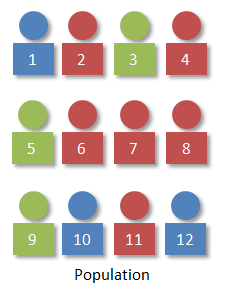
Let'due south suppose you want to select a sample of 4 people from a group of 12 (see image above). Here are some common ways to select a elementary random sample:
- write everyone's name on a slip of paper and describe four from a hat
- write all possible samples of size four on slips of paper and describe one from a lid
- number each individual and use technology to randomly select four integers betwixt 1 and 30
Practically, the first two lost their effectiveness with large groups, so we'll be focusing on the latter method.
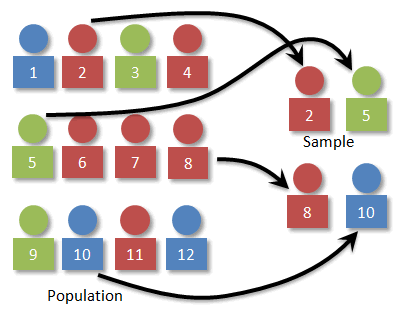
With our case of a sample size iv from a population of 12, we might apply engineering science to select four random integers between 1 and 12. Say we go two, v, 8, and 10. Our sample would then look this this:
For another take, watch this YouTube video by Steve Mays.
Random
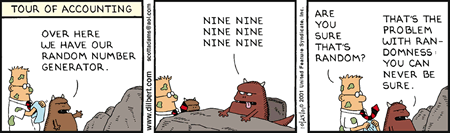
The only thing left to practice, then, is to generate a random number. Only how do yous do that? But pick a number from your head?
For a good caption, watch this video from Clive Rix, at the Academy of Leicester in England.
OK, and so how do we really generate a random number? The "Technology" box below shows how to generate what are called "pseudo random numbers", which is a reasonable enough technique for this form.
To become a truthful random number, you need something more than sophisticated. I solution is random.org. For information virtually randomness and the divergence between pseudo random numbers and truthful random numbers, you can visit their folio on an Introduction to Randomness and Random Numbers.
For the purposes of this class, experience free to apply the instructions below.
Technology
Here'southward a quick overview of how to generate random integers in StatCrunch.
- Select Data > Simulate Data > Uniform
- Enter northward for Rows and one for Columns
- Enter the lower and upper limits for a and b.
- Press Simulate
You tin manually round each value, or StatCrunch can exercise it for you. To round, follow these steps:
- Select Data > Compute expression
- Set Y to Uniform1.
- Select "round(Y)" in the expression dropbox (it's the very last expression).
- Press Set Expression and printing Compute.
Stratified Sampling
Stratified sampling is dissimilar. With this technique, we separate the population using some characteristic, and and so take a proportional random sample from each.
A stratified sample is obtained by separating the population into non-overlapping groups called strata so obtaining a proportional simple random sample from each group. The individuals inside each group should be similar in some mode.
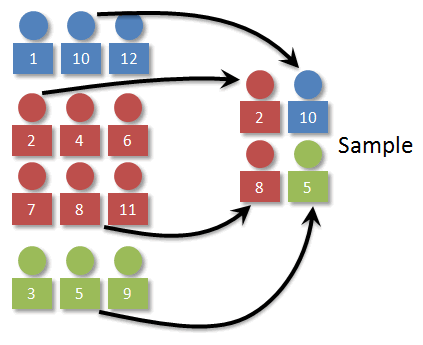
Visually, information technology might look something like the image below. With our population, we can hands separate the individuals by color.
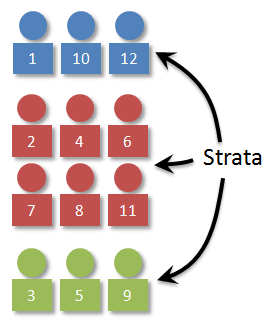
Once nosotros have the strata adamant, we need to decide how many individuals to select from each stratum. (Man, that'due south a weird word!) The key hither is that the number selected should be proportional. In our case, ane/4 of the individuals in the population are blue, so 1/iv of the sample should exist blueish as well. Working things out, nosotros tin can meet that a stratified (past color) random sample of 4 should have 1 blue, 1 green, and two reds.
For another take, scout this YouTube video:
Instance ane
One easy instance using a stratified technique would exist a sampling of people at ECC. To make sure that a sufficient number of students, kinesthesia, and staff are selected, we would stratify all individuals by their status - students, faculty, or staff. (These are the strata.) And so, a proportional number of individuals would be selected from each group.
Systematic Sampling
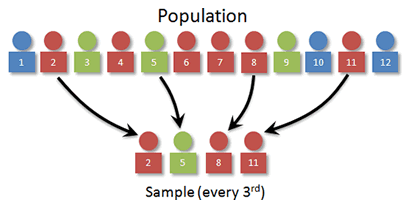
A systematic sample is obtained past selecting every mth private from the population. The offset private selected corresponds to a random number between 1 and yard.
So to apply systematic sampling, we need to first order our individuals, and so select every kth. (More on how to select k in a bit.)
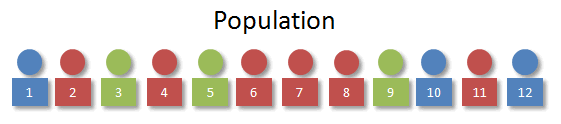
In our instance, we want to use 3 for k? Can y'all meet why? Think what would happen if we used ii or 4.
For our starting point, we selection a random number between 1 and g. For our visual, permit's suppose that we pick 2. The individuals sampled would then be 2, 5, 8, and eleven.
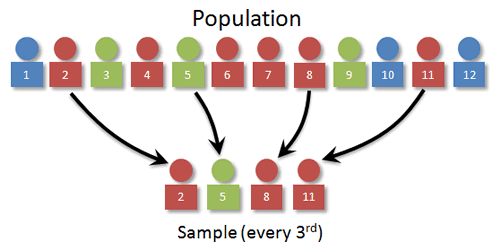
In full general we notice k by taking Due north/n and rounding downward to the nearest integer.
For another have, spotter this YouTube video:
Example two
Systematic sampling works well when the individuals are already lined up in club. In the past, students have often used this method when asked to survey a random sample of ECC students. Since nosotros don't have admission to the complete list, simply stand at a corner and pick every 10th* person walking by.
* Of class, choosing x here is just an example. It would depend on the number of students typically passing by that spot and what sample size was needed.
Cluster Sampling
Cluster sampling is often confused with stratified sampling, because they both involve "groups". In reality, they're very unlike. In stratified sampling, we separate the population upward into groups (strata) based on some characteristic.
A cluster sample is obtained by selecting all individuals within a randomly selected collection or group of individuals.
In essence, we use cluster sampling when our population is already broken up into groups (clusters), and each cluster represents the population. That mode, we merely select a certain number of clusters.
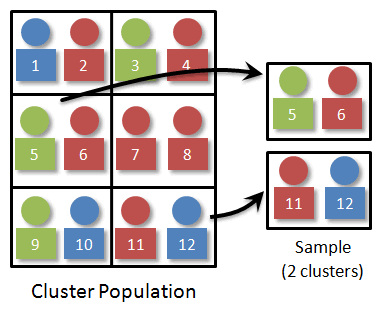
With our visual, let's suppose the 12 individuals are paired upwards merely as they were sitting in the original population.
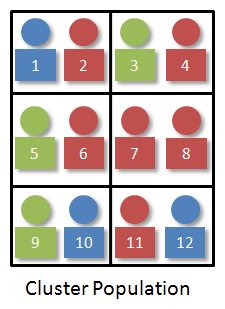
Since we want a random sample of size four, we just select two of the clusters. We would number the clusters ane-six and use technology to randomly select two random numbers. It might look something like this:
For another take, watch this YouTube video:
Instance 3
1 situation where cluster sampling would use might be in manufacturing. Suppose your company makes calorie-free bulbs, and y'all'd like to test the effectiveness of the packaging. You lot don't have a complete list, so simple random sampling doesn't apply, and the bulbs are already in boxes, and then you lot tin't guild them to utilise systematic. And all the bulbs are essentially the same, then there aren't whatever characteristics with which to stratify them.
To use cluster sampling, a quality control inspector might select a certain number of entire boxes of bulbs and examination each bulb within those boxes. In this instance, the boxes are the clusters.
Convenience Sampling
Other methods do exist for finding samples of populations. In fact, y'all've seen some already. Probably the nearly common is the and so-called convenience sample. Convenience samples are just what they sound like - convenient. Unfortunately, they're rarely representative. Call up of the radio call-in prove, those people in the shopping malls trying to survey you well-nigh your purchasing habits, or fifty-fifty the voting on American Idol!
Here'due south a specific instance. It's a poll on beliefnet.com, titled "What Evangelicals Want". All online polls utilise, by nature, convenience sampling. According to the article, "The poll was promoted on Beliefnet's web site and through its newsletters." Only those evangelicals who visit this item spider web site and really reply the survey are included. Beware whatever poll event taken with convenience sampling.
Multistage Sampling
Oft one technique isn't possible, so many professional polling agencies use a technique called multistage sampling. The strategy is relatively self-explanatory - two or more sampling techniques are used.
For example, consider the calorie-free-bulb example we looked at earlier with cluster sampling. Let's suppose that the bulbs come off the assembly line in boxes that each incorporate 20 packages of iv bulbs each. One strategy would be to do the sample in two stages:
Stage 1: A quality control engineer removes every 200th box coming off the line. (The plant produces 5,000 boxes daily. (This is systematic sampling.)
Stage 2: From each box, the engineer so samples iii packages to inspect. (This is an example of cluster sampling.)
The United states Census besides uses multistage sampling. If you oasis't already (you should accept!), read Section 1.4 in your text for more details.
Summary
Here's a visual summary of the four primary sampling strategies:
Elementary Random:
Stratified:
Systematic:
Cluster:

How Many Simple Random Samples Of Size 3 Can Be Selected From A Population Of Size 7,
Source: https://faculty.elgin.edu/dkernler/statistics/ch01/1-3.html
Posted by: wheelerliewen.blogspot.com
0 Response to "How Many Simple Random Samples Of Size 3 Can Be Selected From A Population Of Size 7"
Post a Comment